Vol. 3 No. 8 (2026)

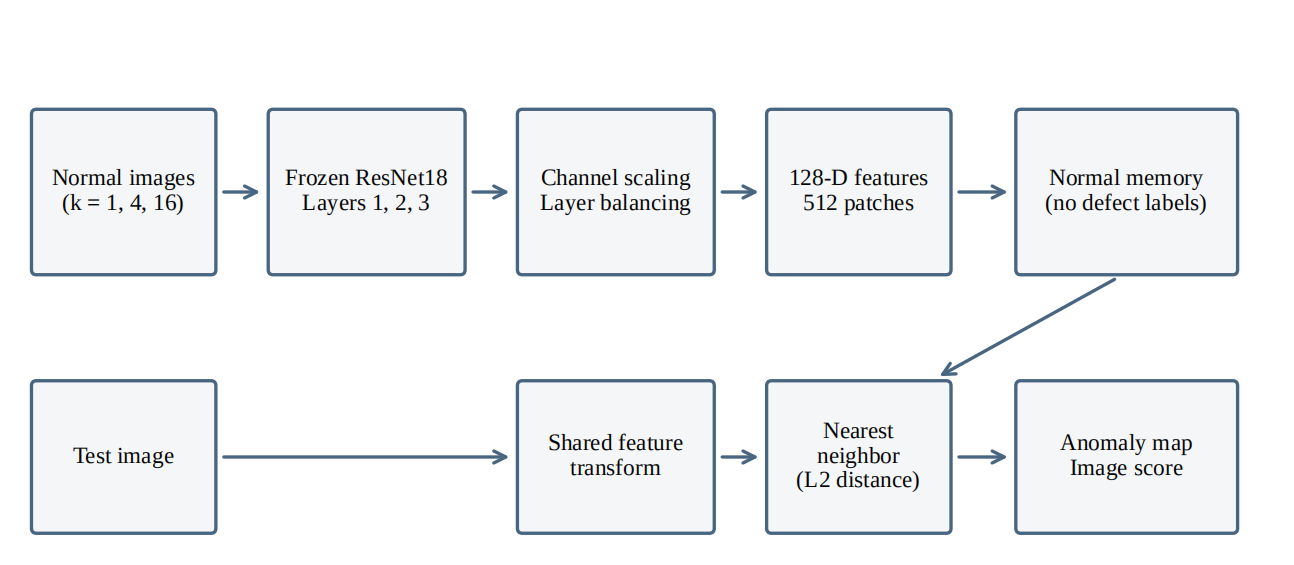
This issue's feature study addresses a persistent bottleneck in industrial visual inspection: how to detect surface defects on ceramic tiles when representative defect samples are scarce and pixel-level annotation is expensive. The authors evaluate lightweight, memory-based anomaly detection models built from only a handful of normal images, using multiscale features extracted by a frozen ResNet18 backbone. Tested across the Tile, Grid, and Wood categories of the MVTec AD benchmark under one-, four-, and sixteen-shot settings, the four-shot Tile configuration reaches 97.92% image-level AUROC and 93.61% pixel-level AUROC. Rather than claiming uniform superiority, the study offers a careful, reproducible comparison of accuracy and computational tradeoffs in few-normal-shot anomaly detection.