Vol. 3 No. 9 (2026)

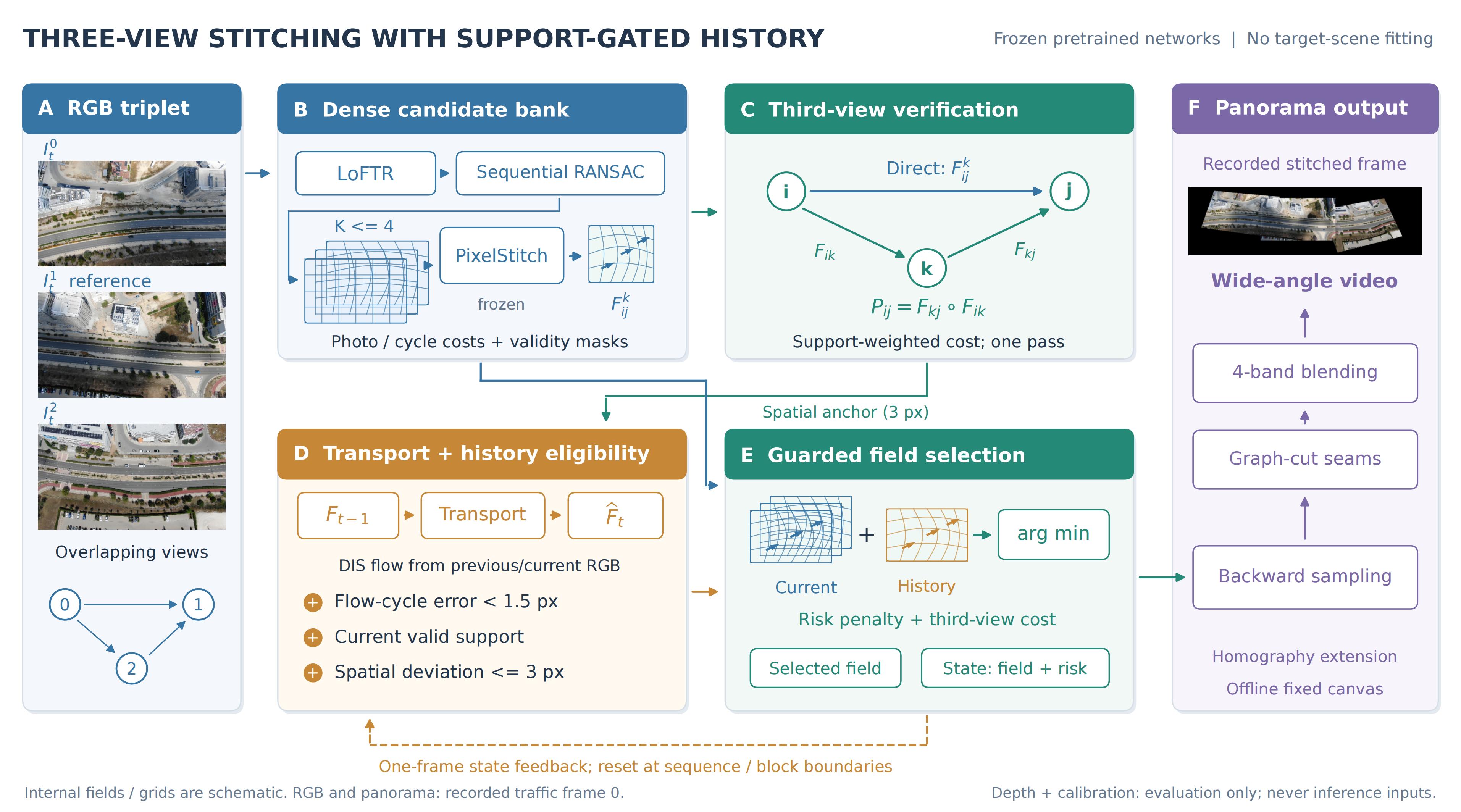
This issue’s featured study examines three-view aerial video stitching, focusing on spatial alignment and the control of historical warp drift. The authors evaluate a dense hypothesis-selection system that combines third-view observations with a bounded historical proposal, without additional target-specific training. Evaluated on six held-out SynDrone towns and three held-out ETH3D ground-based camera-rig scenes, the method increases synthetic alignment success within three pixels from 70.576% to 71.033% compared with a four-candidate pairwise control. Ablation results attribute nearly all of this gain to spatial verification, while the historical mechanism shows no consistent additional benefit. Rather than claiming real-time performance or uniform superiority, the study presents a reproducible assessment of alignment accuracy, computational cost, and the limits of historical information in three-view stitching.