
Development of UAV Swarm Ad-Hoc Network Communication Technology for Emergency Scenarios: A Review
DOI:
https://doi.org/10.62677/IJETAA.2606160Keywords:
UAV swarm, Ad-hoc network, Emergency communication, Routing protocol, Federated learning, Semantic communication, Space-air-ground integrationAbstract
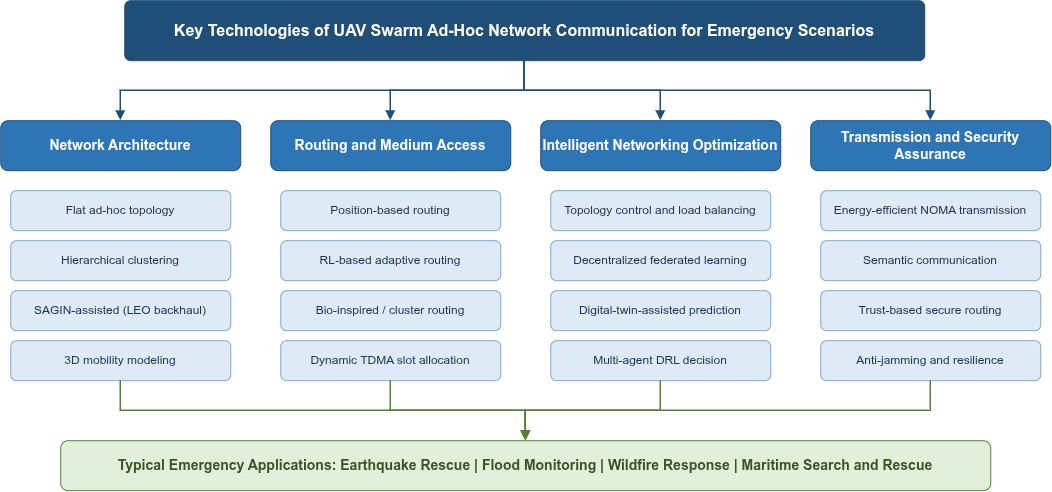
Major disasters such as earthquakes, floods, and wildfires can rapidly destroy terrestrial communication infrastructure, producing an extreme operating environment in which power, road, and network outages compound one another. Owing to their rapid deployability, flexible networking, and three-dimensional mobility, unmanned aerial vehicle (UAV) swarms are being studied as a flexible component of emergency communication systems. This paper reviews UAV swarm ad-hoc network communication technology for emergency scenarios. It examines the technical characteristics and applicability boundaries of three network architectures---flat, hierarchical clustering, and space-air-ground integrated---and surveys recent advances in routing and medium access, intelligent networking optimization, and transmission and security assurance. Particular attention is given to the reported performance and applicability of emerging approaches, including reinforcement-learning-based adaptive routing, decentralized federated learning, digital twins, and semantic communication, under highly dynamic and resource-constrained conditions. Drawing on studies of emergency routing, post-disaster data collection, semantic forwarding, and multi-layer coverage, the paper assesses current validation methods and outlines research directions in energy use, scalability, security, resilience, and standardization. Its contribution is a cross-layer comparison that relates architecture choices to protocol requirements, implementation costs, and validation maturity.
Downloads
References
M. Mozaffari, X. Lin, and S. Hayes, “Toward 6G with connected sky: UAVs and beyond,” IEEE Communications Magazine, vol. 59, no. 12, pp. 74–80, 2021. doi: 10.1109/MCOM.005.2100142 DOI: https://doi.org/10.1109/MCOM.005.2100142
M. Giordani and M. Zorzi, “Non-terrestrial networks in the 6G era: Challenges and opportunities,” IEEE Network, vol. 35, no. 2, pp. 244–251, 2021. doi: 10.1109/MNET.011.2000493 DOI: https://doi.org/10.1109/MNET.011.2000493
M. M. Azari, S. Solanki, S. Chatzinotas, et al., “Evolution of non-terrestrial networks from 5G to 6G: A survey,” IEEE Communications Surveys & Tutorials, vol. 24, no. 4, pp. 2633–2672, 2022. doi: 10.1109/COMST.2022.3199901 DOI: https://doi.org/10.1109/COMST.2022.3199901
N. Cheng, J. He, Z. Yin, et al., “6G service-oriented space-air-ground integrated network: A survey,” Chinese Journal of Aeronautics, vol. 35, no. 9, pp. 1–18, 2022. doi: 10.1016/j.cja.2021.12.013 DOI: https://doi.org/10.1016/j.cja.2021.12.013
D. He, W. Yuan, J. Wu, and R. Liu, “Ubiquitous UAV communication enabled low-altitude economy: Applications, techniques, and 3GPP's efforts,” IEEE Network, vol. 40, no. 1, pp. 115–122, 2026. doi: 10.1109/MNET.2025.3574922 DOI: https://doi.org/10.1109/MNET.2025.3574922
A. Heidari, N. J. Navimipour, M. Unal, and G. Zhang, “Machine learning applications in Internet-of-Drones: Systematic review, recent deployments, and open issues,” ACM Computing Surveys, vol. 55, no. 12, pp. 1–45, 2023. doi: 10.1145/3571728 DOI: https://doi.org/10.1145/3571728
A. H. Wheeb, R. Nordin, A. A. Samah, M. H. Alsharif, and M. A. Khan, “Topology-based routing protocols and mobility models for flying ad hoc networks: A contemporary review and future research directions,” Drones, vol. 6, no. 1, p. 9, 2022. doi: 10.3390/drones6010009 DOI: https://doi.org/10.3390/drones6010009
O. T. Abdulhae, J. S. Mandeep, and M. Islam, “Cluster-based routing protocols for flying ad hoc networks (FANETs),” IEEE Access, vol. 10, pp. 32981–33004, 2022. doi: 10.1109/ACCESS.2022.3161446 DOI: https://doi.org/10.1109/ACCESS.2022.3161446
G. Asaamoning, P. Mendes, and N. Magaia, “A dynamic clustering mechanism with load-balancing for flying ad hoc networks,” IEEE Access, vol. 9, pp. 158574–158586, 2021. doi: 10.1109/ACCESS.2021.3130417 DOI: https://doi.org/10.1109/ACCESS.2021.3130417
J. Xu, M. A. Kishk, and M.-S. Alouini, “Space-air-ground-sea integrated networks: Modeling and coverage analysis,” IEEE Transactions on Wireless Communications, vol. 22, no. 9, pp. 6298–6313, 2023. doi: 10.1109/TWC.2023.3241341 DOI: https://doi.org/10.1109/TWC.2023.3241341
G. Geraci, D. López-Pérez, M. Benzaghta, and S. Chatzinotas, “Integrating terrestrial and non-terrestrial networks: 3D opportunities and challenges,” IEEE Communications Magazine, vol. 61, no. 4, pp. 42–48, 2023. doi: 10.1109/MCOM.002.2200366 DOI: https://doi.org/10.1109/MCOM.002.2200366
T. Liu, G. Bai, J. Tao, Y.-A. Zhang, and Y. Fang, “A multistate network approach for resilience analysis of UAV swarm considering information exchange capacity,” Reliability Engineering & System Safety, vol. 241, p. 109606, 2024. doi: 10.1016/j.ress.2023.109606 DOI: https://doi.org/10.1016/j.ress.2023.109606
M. Kaur, D. Prashar, L. Mrsic, and A. A. Khan, “Machine learning-based routing protocol in flying ad hoc networks: A review,” Computers, Materials & Continua, vol. 82, no. 2, pp. 1615–1643, 2025. doi: 10.32604/cmc.2025.059043 DOI: https://doi.org/10.32604/cmc.2025.059043
J. Lánský, S. Ali, A. M. Rahmani, et al., “Reinforcement learning-based routing protocols in flying ad hoc networks (FANET): A review,” Mathematics, vol. 10, no. 16, p. 3017, 2022. doi: 10.3390/math10163017 DOI: https://doi.org/10.3390/math10163017
L. Zhang, X. Ma, Z. Zhuang, H. Xu, V. Sharma, and Z. Han, “Q-learning aided intelligent routing with maximum utility in cognitive UAV swarm for emergency communications,” IEEE Transactions on Vehicular Technology, vol. 72, no. 3, pp. 3707–3723, 2023. doi: 10.1109/TVT.2022.3221538 DOI: https://doi.org/10.1109/TVT.2022.3221538
S. Yang, S. Wang, T. Li, et al., “Hybrid ant colony-based inter-cluster routing protocol for FANET,” Scientific Reports, vol. 14, art. no. 15632, 2024. doi: 10.1038/s41598-024-64454-1 DOI: https://doi.org/10.1038/s41598-024-64454-1
H. Dong, B. Yu, and W. Wu, “Routing protocol for intelligent unmanned cluster network based on node energy consumption and mobility optimization,” Sensors, vol. 25, no. 2, p. 500, 2025. doi: 10.3390/s25020500 DOI: https://doi.org/10.3390/s25020500
L. Song and D. Guo, “Slot allocation protocol for UAV swarm ad hoc networks: A distributed coalition formation game approach,” Entropy, vol. 27, no. 3, p. 256, 2025. doi: 10.3390/e27030256 DOI: https://doi.org/10.3390/e27030256
M. Hosseinzadeh, A. H. Mohammed, F. A. Alenizi, et al., “A novel fuzzy trust-based secure routing scheme in flying ad hoc networks,” Vehicular Communications, vol. 44, p. 100665, 2023. doi: 10.1016/j.vehcom.2023.100665 DOI: https://doi.org/10.1016/j.vehcom.2023.100665
T. M. Getu, G. Kaddoum, and M. Bennis, “Semantic communication: A survey on research landscape, challenges, and future directions,” Proceedings of the IEEE, vol. 112, no. 11, pp. 1649–1685, 2024. doi: 10.1109/JPROC.2024.3520707 DOI: https://doi.org/10.1109/JPROC.2024.3520707
J. Xu, K. Ota, and M. Dong, “Ideas in the air: Unmanned aerial semantic communication for post-disaster scenarios,” IEEE Wireless Communications Letters, vol. 14, no. 6, pp. 1598–1602, 2025. doi: 10.1109/LWC.2025.3530760 DOI: https://doi.org/10.1109/LWC.2025.3530760
X. Zheng, G. Sun, J. Li, et al., “Low-altitude multi-UAV-assisted data collection and semantic forwarding for post-disaster relief,” arXiv preprint arXiv:2601.16146, 2026. doi: 10.48550/arXiv.2601.16146
Y. Qu, H. Dai, Y. Zhuang, et al., “Decentralized federated learning for UAV networks: Architecture, challenges, and opportunities,” IEEE Network, vol. 35, no. 6, pp. 156–162, 2021. doi: 10.1109/MNET.001.2100253 DOI: https://doi.org/10.1109/MNET.001.2100253
Y. Xiao, Y. Ye, S. Huang, et al., “Fully decentralized federated learning-based on-board mission for UAV swarm system,” IEEE Communications Letters, vol. 25, no. 10, pp. 3296–3300, 2021. doi: 10.1109/LCOMM.2021.3095362 DOI: https://doi.org/10.1109/LCOMM.2021.3095362
Y. Ding, Z. Yang, Q.-V. Pham, Y. Hu, Z. Zhang, and M. Shikh-Bahaei, “Distributed machine learning for UAV swarms: Computing, sensing, and semantics,” IEEE Internet of Things Journal, vol. 11, no. 5, pp. 7447–7473, 2024. doi: 10.1109/JIOT.2023.3341307 DOI: https://doi.org/10.1109/JIOT.2023.3341307
B. Jiang, J. Du, C. Jiang, Z. Han, A. Alhammadi, and M. Debbah, “Over-the-air federated learning in digital twins empowered UAV swarms,” IEEE Transactions on Wireless Communications, vol. 23, no. 11, pp. 17619–17634, 2024. doi: 10.1109/TWC.2024.3455009 DOI: https://doi.org/10.1109/TWC.2024.3455009
L. Zhou, S. Leng, Q. Wang, T. Q. S. Quek, and M. Guizani, “Cooperative digital twins for UAV-based scenarios,” IEEE Communications Magazine, vol. 63, no. 3, pp. 40–46, 2025. doi: 10.1109/MCOM.001.2400207 DOI: https://doi.org/10.1109/MCOM.001.2400207
J. Chen, B. Li, H. Sun, S. Cui, and N. Pappas, “Predictive communications for low-altitude networks,” IEEE Internet of Things Magazine, vol. 9, no. 3, pp. 25–32, 2026. doi: 10.1109/MIOT.2026.3658070 DOI: https://doi.org/10.1109/MIOT.2026.3658070
S. Fu, X. Guo, F. Fang, Z. Ding, N. Zhang, and N. Wang, “Towards energy-efficient data collection by unmanned aerial vehicle base station with NOMA for emergency communications in IoT,” IEEE Transactions on Vehicular Technology, vol. 72, no. 1, pp. 1211–1223, 2023. doi: 10.1109/TVT.2022.3206213 DOI: https://doi.org/10.1109/TVT.2022.3206213
Y. Huang, J. Yang, S. Xia, C.-K. Wen, and S. Jin, “Learned off-grid imager for low-altitude economy with cooperative ISAC network,” IEEE Transactions on Wireless Communications, vol. 25, pp. 3333–3348, 2026. doi: 10.1109/TWC.2025.3603255 DOI: https://doi.org/10.1109/TWC.2025.3603255
Downloads
Published
Issue
Section
Categories
License
Copyright (c) 2026 Yi Ren, Huatao Zhu, Jie Zhang (Author)

This work is licensed under a Creative Commons Attribution-NonCommercial 4.0 International License.
How to Cite


