
Error Discovery and Label Utility in Cross-Domain Waste Classification
DOI:
https://doi.org/10.62677/IJETAA.2610158Keywords:
Active learning, Domain adaptation, Waste classification, Annotation budgets, Model disagreementAbstract
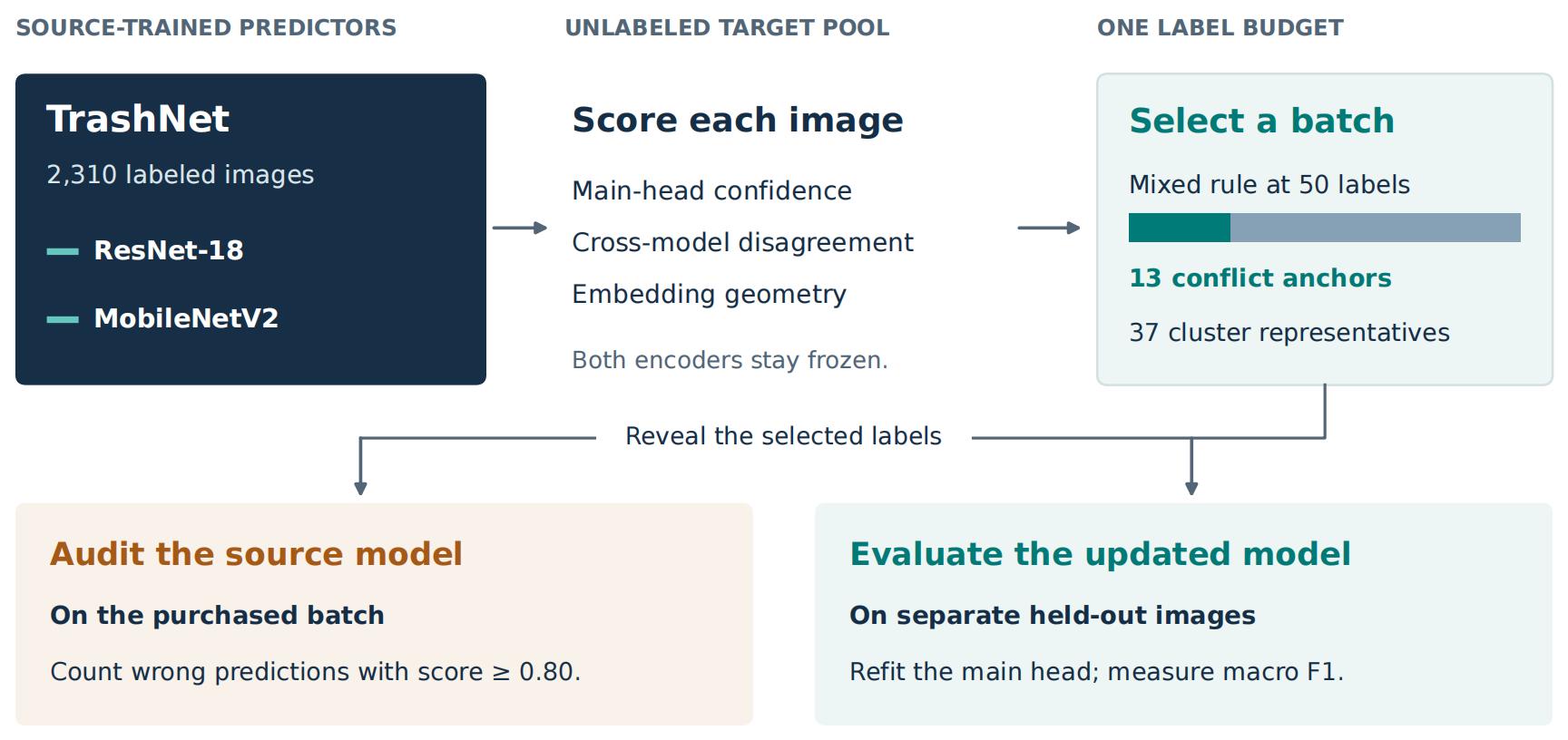
When a waste classifier encounters unfamiliar images, its most revealing mistakes may be poor examples for retraining. We examined this distinction in a single round of label acquisition for five materials. Two frozen image encoders with classification heads fitted on TrashNet supplied the scores for eight selection policies at budgets of 25, 50 and 100 labels. On RealWaste landfill photographs, we developed a policy that combines classifier disagreement with representative examples from the remaining pool. At 50 labels, mean held-out macro F1 was 0.636 for this policy and 0.593 for random sampling. We then applied the same rule to litter objects cropped from TACO using supplied bounding boxes. Across five paired candidate pools, mean macro F1 was 0.571 for the mixed policy and 0.585 for random sampling. The difference was −1.45 macro F1 points (conditional 95 percent bootstrap interval, −5.42 to +2.65). In a separate RealWaste analysis, selecting from the largest disagreement groups found 33.8 high-confidence errors per 50 labels, compared with 25.8 for random sampling within the same shortlist. Those batches nevertheless yielded lower held-out macro F1 (0.544 versus 0.621). Disagreement helped identify failures worth inspecting, but error counts alone did not predict the benefit of retraining.
Downloads
References
M. Yang and G. Thung, “Classification of trash for recyclability status,” Stanford Univ., Stanford, CA, USA, CS229 Project Rep., 2016. Accessed: Nov. 26, 2026. [Online]. Available: https://cs229.stanford.edu/proj2016/report/ThungYang-ClassificationOfTrashForRecyclabilityStatus-report.pdf
S. Single, S. Iranmanesh, and R. Raad, “RealWaste: A novel real-life data set for landfill waste classification using deep learning,” Information, vol. 14, no. 12, 2023, Art. no. 633, doi: 10.3390/info14120633.
P. F. Proença and P. Simões, “TACO: Trash annotations in context dataset,” ver. 1.0, Zenodo, Jun. 9, 2019, dataset, doi: 10.5281/zenodo.3587843.
M. Echchidmi and A. Bouayad, “Compact waste image classification with multi-student CNNs and edge-oriented model selection,” Front. Artif. Intell., vol. 9, 2026, Art. no. 1804734, doi: 10.3389/frai.2026.1804734.
J. V. Funk, P. Bäcker, L. Roming, J. Josekutty, G. Maier, and T. Längle, “Evaluation of vision–language models for waste classification: Zero- and few-shot with a training-free tip-adapter,” Cleaner Waste Syst., vol. 13, 2026, Art. no. 100475, doi: 10.1016/j.clwas.2026.100475.
M. M. Hossen et al., “A reliable and robust deep learning model for effective recyclable waste classification,” IEEE Access, vol. 12, pp. 13809–13821, 2024, doi: 10.1109/ACCESS.2024.3354774.
A. Patrizi, G. Gambosi, and F. M. Zanzotto, “Data augmentation using background replacement for automated sorting of littered waste,” J. Imaging, vol. 7, no. 8, 2021, Art. no. 144, doi: 10.3390/jimaging7080144.
K. Maleknya, R. Alizadehsani, S. Pedrammehr, and K. Shirini, “A solid waste classification using reinforcement learning boosted by data augmentation and hyperparameter optimization,” Sci. Rep., vol. 16, no. 1, 2026, Art. no. 18132, doi: 10.1038/s41598-026-46347-7.
T. T. Le, T. N. Chu, and M. H. Nguyen, “A controlled benchmark of active learning strategies for class-imbalanced waste detection on SortWaste with YOLO,” Int. J. Adv. Comput. Sci. Appl., vol. 17, no. 10, pp. 1429–1442, 2026, doi: 10.14569/IJACSA.2026.01710123.
P. Munjal, N. Hayat, M. Hayat, J. Sourati, and S. Khan, “Towards robust and reproducible active learning using neural networks,” in Proc. IEEE/CVF Conf. Comput. Vis. Pattern Recognit. (CVPR), 2022, pp. 223–232, doi: 10.1109/CVPR52688.2022.00032.
J. Auh, C. Cho, and S.-T. Kim, “Adaptive active learning with dynamic uncertainty-diversity balancing for object detection,” J. Intell. Robot. Syst., vol. 112, no. 2, 2026, Art. no. 45, doi: 10.1007/s10846-026-02380-2.
S. Mittal et al., “Realistic evaluation of deep active learning for image classification and semantic segmentation,” Int. J. Comput. Vis., vol. 133, no. 7, pp. 4294–4316, 2025, doi: 10.1007/s11263-025-02372-z.
J.-C. Su, Y.-H. Tsai, K. Sohn, B. Liu, S. Maji, and M. Chandraker, “Active adversarial domain adaptation,” in Proc. IEEE Winter Conf. Appl. Comput. Vis. (WACV), 2020, pp. 728–737, doi: 10.1109/WACV45572.2020.9093390.
V. Prabhu, A. Chandrasekaran, K. Saenko, and J. Hoffman, “Active domain adaptation via clustering uncertainty-weighted embeddings,” in Proc. IEEE/CVF Int. Conf. Comput. Vis. (ICCV), 2021, pp. 8485–8494, doi: 10.1109/ICCV48922.2021.00839.
K. Zhou, Z. Liu, Y. Qiao, T. Xiang, and C. C. Loy, “Domain generalization: A survey,” IEEE Trans. Pattern Anal. Mach. Intell., vol. 45, no. 4, pp. 4396–4415, Apr. 2023, doi: 10.1109/TPAMI.2022.3195549.
C. Tomani, S. Gruber, M. E. Erdem, D. Cremers, and F. Buettner, “Post-hoc uncertainty calibration for domain drift scenarios,” in Proc. IEEE/CVF Conf. Comput. Vis. Pattern Recognit. (CVPR), 2021, pp. 10119–10127, doi: 10.1109/CVPR46437.2021.00999.
S. Kapoor and A. Narayanan, “Leakage and the reproducibility crisis in machine-learning-based science,” Patterns, vol. 4, no. 9, 2023, Art. no. 100804, doi: 10.1016/j.patter.2023.100804.
K. He, X. Zhang, S. Ren, and J. Sun, “Deep residual learning for image recognition,” in Proc. IEEE Conf. Comput. Vis. Pattern Recognit. (CVPR), 2016, pp. 770–778, doi: 10.1109/CVPR.2016.90.
M. Sandler, A. Howard, M. Zhu, A. Zhmoginov, and L.-C. Chen, “MobileNetV2: Inverted residuals and linear bottlenecks,” in Proc. IEEE/CVF Conf. Comput. Vis. Pattern Recognit. (CVPR), 2018, pp. 4510–4520, doi: 10.1109/CVPR.2018.00474.
J. Opitz, “A closer look at classification evaluation metrics and a critical reflection of common evaluation practice,” Trans. Assoc. Comput. Linguist., vol. 12, pp. 820–836, 2024, doi: 10.1162/tacl_a_00675.
Downloads
Published
Issue
Section
Categories
License
Copyright (c) 2026 Chenwu Li (Author)

This work is licensed under a Creative Commons Attribution-NonCommercial 4.0 International License.
How to Cite


